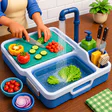
Kitchen Set Fun Cooking Time
Digital-CamelRole Playing
4.24.00 Reviews
- Version
- 1.0.1
- Installs
- 1.00M
- Age Rating
- Everyone
Screenshots







Our Review of Kitchen Set Fun Cooking Time
 Analysis by Appyee
I spent time with Kitchen Set Fun Cooking Time as a light role-playing game built around kitchen activity, serving food, and a playful cooking adventure. Its central appeal is easy to understand: you prepare dishes, work through kitchen tasks, and enjoy a relaxed food-themed setting rather than entering a dramatic fantasy world or a demanding competitive arena. That makes it approachable, especially when I want something simple to pick up for a short session.
The game is free to download, and Digital-Camel presents it for everyone rather than for a narrow age group. It belongs to the role-playing category, although its role-playing identity is much gentler than the character-heavy adventures I usually associate with that label. Here, the feeling of progression comes from taking part in the kitchen routine and completing cooking-focused activities. I would describe it as a casual role-playing experience with a cooking theme, not as a deep simulation of professional food preparation.
My first impression was shaped by how quickly the game communicates its purpose. There is no need to learn a complicated fictional history before getting started. The kitchen setting does most of the explanatory work: food, preparation, serving, and the promise of an enjoyable cooking session establish the mood immediately. That directness is useful for younger players and for anyone who prefers an app that gets to its main activity without a long introduction.
A cheerful kitchen world that keeps the focus on play
The visual language is built around the idea of a friendly kitchen set. Instead of trying to make cooking look harsh, technical, or realistic, the presentation aims for a welcoming playroom atmosphere. That choice matters because it keeps the experience emotionally light. I never approached a session expecting a strict culinary lesson; I approached it as a small interactive adventure where kitchen objects and food preparation create the setting.
The setting also gives the game a clear identity. Many role-playing games rely on castles, dungeons, futuristic cities, or elaborate character stories. This one uses the kitchen as its stage, which makes the ordinary feel like the place where the adventure happens. A countertop, cooking tools, ingredients, and serving tasks become the vocabulary of the game. That is a smart fit for a casual title because the player understands the basic situation without needing a detailed explanation.
What I particularly like is the way the theme can make routine actions feel purposeful. Preparing food is not presented as a detached puzzle with a random skin; the kitchen context gives those actions a reason. When the game asks me to move through cooking-related work, the setting helps me read each step as part of a small service routine. That connection between action and place is one of the more successful parts of the experience.
There is a trade-off, though. A kitchen theme can feel repetitive if the player is looking for a large world to explore or a story that changes dramatically from one session to the next. The setting is coherent precisely because it stays focused. If you want a role-playing game with extensive dialogue, exploration, equipment choices, or a broad cast of characters, this will feel much narrower. I see that limitation as intentional, but it still determines who will enjoy the game.
How the art direction supports the cooking fantasy
The art direction works best when it treats the kitchen as a playful space rather than a realistic workplace. That makes the game less intimidating for first-time players. You do not need to know culinary terminology or understand professional kitchen organization to follow what is happening. The visual presentation invites experimentation at a basic level, even when the underlying activity is structured.
This approach is also useful for shared play around a phone or tablet. A child can recognize the purpose of common kitchen actions, while an adult can understand the sequence quickly enough to offer guidance without taking over. I can imagine it working well during a quiet break, when someone wants a colorful activity that does not demand the concentration of a strategy game.
At the same time, the presentation should not be mistaken for a full cooking simulator. The appeal lies in the fantasy of preparing and serving food, not in reproducing every detail of a real recipe. If your goal is to learn accurate techniques, timing, food safety, or ingredient science, a dedicated educational cooking app would be a better choice. This game is more about accessible interaction and mood than practical instruction.
Sound, pacing, and the feeling of a short session
The audio and pacing are important because a cooking game can easily become tiring if every action feels rushed. In my experience, the best moments come when the game lets the kitchen theme breathe. The overall mood is more comfortable when the sequence of tasks feels like a playful routine instead of an aggressive test of speed. That makes it easier to return to the game casually rather than treating every session as a challenge that must be conquered.
The rhythm also affects how suitable the game is for different situations. I would use it as a short distraction after work, during a waiting period, or when I wanted something more interactive than scrolling through videos. It does not demand the same mental investment as a long role-playing adventure. I can begin with a simple intention—prepare food, serve it, and see where the activity leads—and stop without feeling that I have abandoned a complicated storyline.
That relaxed rhythm is a strength for younger players and casual users, but it may be a weakness for people who need constant escalation. Players who enjoy rapid action, difficult timing windows, or a strong competitive loop may find the kitchen mood too gentle. The game’s identity depends on its accessible pace, so I would not recommend it to someone searching for an intense cooking contest or a mechanically demanding role-playing system.
One practical tip is to approach each session as a small routine rather than trying to force a long play period. The kitchen theme works better when I allow the actions to form a compact sequence. Playing in short bursts also makes the repeated setting feel less overwhelming. This is a simple change in expectations, but it improves the experience because the game’s charm is tied to its bite-sized sense of activity.
Role-playing elements without the usual complexity
The role-playing label becomes clearer when viewed through the idea of taking on a kitchen-centered role. You are not simply tapping through unrelated mini-games; you are participating in a food-service fantasy. The preparation and serving focus gives the player a job-like identity, even though the presentation remains playful. For me, that is the bridge between the cooking theme and the category classification.
However, I would keep expectations measured. This is not the kind of role-playing game I would choose for deep character development, branching decisions, tactical battles, or a large inventory system. Its progression is tied to the cooking activity itself. That makes it easier to understand, but it also means the game may not provide enough variety for players who usually spend hours building a character or exploring a changing world.
The mechanical fit is strongest when the player wants an activity with an obvious goal. Food preparation and serving naturally create a beginning, middle, and end: start the kitchen work, complete the relevant steps, and finish the service. Even without a complicated narrative, that structure gives a session direction. I appreciate games that make their purpose clear, and this one does not hide its main loop behind unnecessary systems.
A useful way to play is to focus on consistency rather than speed. Instead of treating every action as a race, I pay attention to the order in which the kitchen tasks appear and use that order to keep the session organized. This makes the experience feel more deliberate and helps reveal whether I enjoy the routine itself. If the basic sequence is satisfying, the game has a good chance of holding my attention; if it feels repetitive immediately, additional play is unlikely to change my opinion.
Who will enjoy it, and who should look elsewhere
I think the game is a good match for players who like food themes, simple role-playing ideas, and colorful activities that are easy to understand. It is also a reasonable option for families looking for an approachable game with an Everyone age rating. A parent or older sibling can explain the basic kitchen concept quickly, and the setting gives younger players something familiar to connect with.
It may also suit adults who want a low-pressure game rather than a serious simulation. I would choose it when I wanted to unwind without learning an elaborate control scheme. The cooking setting provides enough context to make the activity feel purposeful, while the casual structure keeps it from becoming a major commitment.
I would skip it if my priority were realistic recipes, advanced culinary education, a rich role-playing story, or a highly competitive leaderboard-style experience. I would also be cautious if I disliked repeated kitchen routines. A focused theme is valuable, but it can become limiting for players who need frequent changes of scenery or a broad selection of play styles.
The presence of in-app purchases is another point worth considering before handing the game to a child. Optional items range from $1.09 to $4.49 each, so I would review purchase controls on the device first and make sure the player understands that the free download can include paid additions. That does not make the game unsuitable, but it is part of using it responsibly, especially in a family setting.
How it compares with other cooking and role-playing choices
Compared with a dedicated cooking simulator, this game is easier to approach but less useful for learning real kitchen skills. A simulator may reward exact measurements, realistic timing, and recipe knowledge; Kitchen Set Fun Cooking Time is better understood as a playful food adventure. Its advantage is immediacy. I can enter the theme without first learning a complicated set of culinary rules.
Compared with a conventional role-playing game, it offers a much smaller emotional and mechanical footprint. There is no need to remember a large story or manage a complex character build. That simplicity makes it friendlier for short sessions, but it also removes the depth that keeps traditional role-playing fans invested for long periods. The right comparison depends on whether I want a kitchen activity with role-playing flavor or a full adventure that happens to include cooking.
It also differs from fast-paced time-management cooking games in tone. Those games often build excitement through pressure, queues, and quick decisions. This title’s appeal is more closely tied to the setting and the pleasure of completing kitchen actions. If I want to relax, that distinction works in its favor. If I want constant urgency, another cooking game may provide a stronger fit.
Practical details before installing
Digital-Camel is the developer behind the game, which is currently at version 1.0.1 and runs on Android 6.0 or later. That makes the compatibility requirement fairly approachable for people using older supported Android devices. I would still check the device experience personally before recommending it widely, particularly if the game is intended for a child who uses an older phone or tablet.
The game has passed the early discovery stage with over one million installs and an average rating of 4.2 from around 431 ratings. Those figures suggest that the concept has reached a meaningful audience and that the general response is positive. I would treat the rating as a useful signal rather than a guarantee, because enjoyment here depends heavily on whether the player likes a focused cooking routine.
It was released on July 16, 2026, and the current version gives the game a relatively early point in its life. That matters when deciding how much long-term variety to expect. I would install it for the experience it offers now, not solely for the possibility of future expansion. The free entry point makes that decision easier: trying the kitchen loop costs nothing upfront, while paid items remain a separate consideration.
My verdict on the atmosphere and the mechanics
What stays with me is the coherence between the kitchen setting, the gentle role-playing angle, and the manageable pace. The game does not appear to be chasing the scale of a traditional adventure. Instead, it creates a small playable mood around preparing and serving food. When I accept that narrower goal, the experience makes sense: the art direction gives the activity a recognizable home, the sound and rhythm support casual play, and the mechanics keep returning to the same food-centered identity.
The main limitation is also the source of its identity. Because the game stays focused on kitchen activity, players looking for extensive exploration or deep progression may run out of reasons to continue. I would not describe that as a flaw that affects everyone; it is a clear boundary. The game works when the player wants a friendly cooking-themed diversion, and it works less well when the player expects a complete role-playing world.
My final recommendation is therefore selective but positive. I would suggest it to a friend who enjoys approachable cooking games, wants a free casual role-playing experience, or needs something suitable for short, low-pressure sessions. I would explain that the game’s pleasure comes from its setting and routine rather than from complex systems. Its strongest quality is the way the kitchen mood gives simple actions a clear sense of purpose.
If that sounds appealing, Kitchen Set Fun Cooking Time is worth trying, especially because the initial download is free and the age rating keeps the concept broadly accessible. I would play it in compact sessions, keep purchase controls in mind, and judge it by the satisfaction of its cooking rhythm rather than by the standards of a large role-playing adventure. For the right player, that modest ambition is exactly what makes the game enjoyable.
Verdict
Strengths of Kitchen Set Fun Cooking Time
- Simple controls make it easy for children to start cooking independently.
- Bright visuals and playful animations keep younger players engaged.
- Short activities are suitable for quick play sessions.
- Encourages creativity through ingredient and decoration choices.
- Child-friendly gameplay avoids complex rules and difficult time limits.
Limitations of Kitchen Set Fun Cooking Time
- Gameplay may feel repetitive after completing the available recipes.
- Some features or ingredients may require in-app purchases.
- Ads can interrupt play depending on the device and app version.
- Limited challenge may not appeal to older children or adults.
- Requires storage space and may perform poorly on older devices.
Similar Picks in This Category
View All
Hair Dye
CrazyLabs LTD4.4

Monster High™ Beauty Salon
CrazyLabs LTD4.5

Bus Simulator - Bus Games 3D
Jima Apps4.4

Flight Pilot: 3D Simulator
Wildlife Studios4.1


Super Stylist Fashion Makeover
CrazyLabs LTD4.4
Frequently Asked Questions
What is Kitchen Set Fun Cooking Time?
Kitchen Set Fun Cooking Time is a casual cooking game designed mainly for children and families. It lets players prepare virtual dishes by selecting ingredients, following simple cooking steps, and decorating finished meals. The game focuses on colorful visuals, easy controls, and imaginative play rather than realistic culinary difficulty, making it suitable for users who want a relaxed and accessible kitchen experience.
How do you play Kitchen Set Fun Cooking Time?
Gameplay generally involves choosing a recipe, gathering the required ingredients, and completing interactive kitchen activities such as cutting, mixing, frying, baking, or decorating. Each action is guided with straightforward touch controls, so players do not need previous cooking-game experience. The experience is more about exploring the kitchen and completing fun tasks than achieving strict scores or mastering complicated recipes.
Is Kitchen Set Fun Cooking Time suitable for children?
The simple interface and playful cooking activities make Kitchen Set Fun Cooking Time appropriate for younger players, especially those who enjoy pretend cooking and creative games. However, parents should still review the app’s age rating, advertising, and privacy information before installation. If the game includes optional purchases or external links, parental supervision and device restrictions are recommended.
Does Kitchen Set Fun Cooking Time require an internet connection?
The basic cooking activities may work without a continuous internet connection, depending on the version installed and the device platform. Nevertheless, an internet connection can be needed for downloading the app, receiving updates, loading advertisements, or accessing certain additional content. It is best to test the game in offline mode before relying on it during travel or in areas with limited connectivity.
Are there advertisements or in-app purchases in Kitchen Set Fun Cooking Time?
Availability of advertisements and in-app purchases can vary according to the app version, operating system, region, and developer settings. Before downloading, check the Google Play Store or Apple App Store listing for the latest details. Free versions of casual children’s games commonly display ads or offer optional content, so parents should review purchase controls and avoid saving payment details on a child’s device.
Play our best games!


